From Press Release to AI Citation in 24 Hours: Here's the Proof
Updated September 2026.
Most companies publish and pray. We built a system that proves citations happen.
TL;DR
Most companies publish press releases and hope for the best. We built something different: a closed-loop system that proves when AI search engines cite your content. We tested it on 3 live press releases. The result? 41 AI citations detected, including 2 PRs cited the same day they were published.
Meanwhile, the wires' AI-facing layer is thin: PR Newswire serves a 2.6 KB static /llms.txt and PRWeb returns 404 (checked September 2026). Pressonify's llms.txt is ~45 KB and regenerates with every release. Full audit below →
Results: 41 AI Citations Tracked in 48 Hours
We ran real citation scans on three press releases published on Pressonify this week:
| Company | Citations | Time to First Citation |
|---|---|---|
| Pressonify.ai | 34 | Established baseline |
| runthetic | 4 | Same day |
| Sword Software | 3 | Same day |
| Total | 41 | - |
Key findings:
- runthetic: Published January 5th, detected in Perplexity citations the same day
- Sword Software: Also published January 5th, cited within hours
- Pressonify.ai: 34 citations across
/news/,/blog/,/about, and/faqpages
A note on what these citations are: each one points to the customer's release page on pressonify.ai, so the release is the source the AI quotes, with the company's brand, message and link front and centre. (More on why that answer presence matters in citations vs clicks.)
Visual Proof: Atlas Citing Pressonify
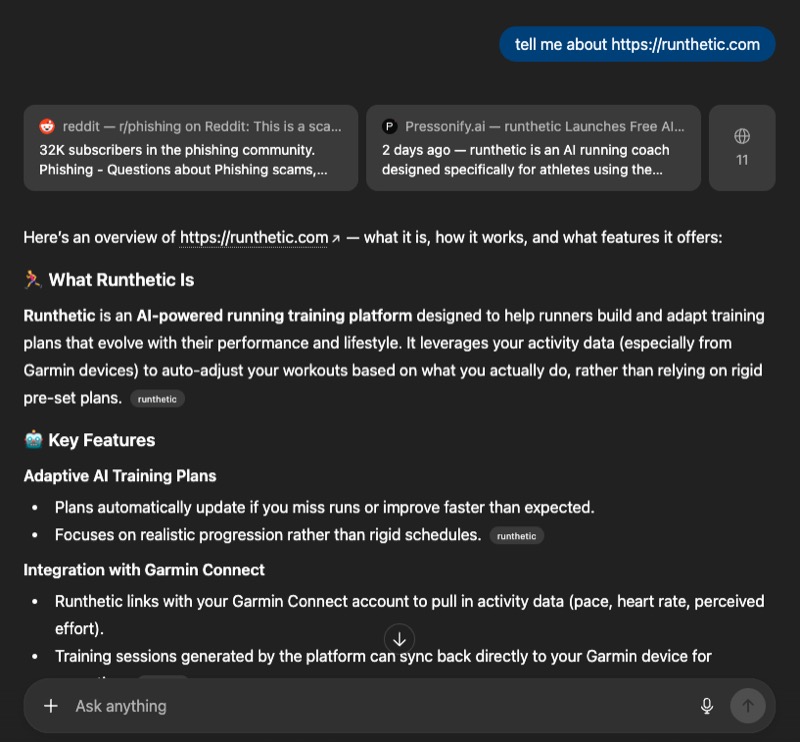
Notice the source card: "Pressonify.ai: runthetic Launches Free AI...", our press release cited as the authoritative source, 2 days after publication. This is the Citation Economy in action. Not theory. Real citations we detected this week.
Can You Track When AI Cites Your Press Release?
Here's an uncomfortable question for every marketing team in 2026: Can you prove your press releases are being cited by AI search engines?
Not impressions. Not potential reach. Actual citations, your company being referenced when someone asks ChatGPT, Perplexity, Claude, or Gemini a question.
Traditional PR distribution is "publish and hope":
- Wire services list from roughly $350 per release plus a $195 membership, and add-ons can push a release past $3,000 (published pricing as of 2026)
- Distribution reports show "potential impressions"
- No visibility into AI search ecosystem
- No way to know if AI systems ever see your content
Meanwhile, 95% of AI citations come from non-paid media (Muck Rack): news articles, earned coverage, and authoritative content. Not paid ads.
How the Closed Loop Works
Every press release on Pressonify is added to our ADP discovery endpoints, ships with Schema.org structured data, and is pinged via IndexNow. Full technical breakdown →
The system tracks four stages:
Publish → Index → Cite → Detect
- Publish: AI-optimized PR goes live with structured data and ADP endpoints
- Index: IndexNow notifies Bing within seconds (Perplexity's primary source)
- Cite: AI search engines discover and cite your content
- Detect: The Citation Tracker queries AI answer engines (Perplexity for every release, plus ChatGPT and Gemini on Premium and Enterprise) about your company on a regular schedule
When your content is cited, you know. Not in a quarterly report. As soon as the next scan runs.
Why This Is Marketing Gold
The closed loop transforms press releases into measurable marketing infrastructure:
Prove ROI to Stakeholders
For example: "We published 10 press releases this quarter. Here are the AI citations each one earned across Perplexity, ChatGPT, and Claude."
That's a sentence you can say with data behind it, whatever the number turns out to be.
Identify Winning Content
Which press releases get cited most? What topics drive AI visibility? The closed loop gives you data to optimize future content.
First-Mover Advantage
AI citation slots are limited, most AI responses cite 2-6 sources. The companies building AI visibility now will own those citation slots for years.
Your Competitors Are Being Cited Right Now
AI citation is zero-sum. When Perplexity answers "What's the best AI running coach?" it cites 2-6 sources. If runthetic is there and you're not, runthetic wins. Every day you wait, competitors are claiming those citation slots.
The question isn't whether to invest in AI visibility. It's whether you'll be cited, or invisible.
The Traditional PR Industry Is Unprepared
We checked the major wire services (September 2026):
| Platform | /llms.txt | ADP Endpoints (ai.json, ai-discovery.json, knowledge-graph.json) |
|---|---|---|
| PR Newswire | 2.6 KB static file | 0 (all 404) |
| eReleases | 3.2 KB static file | 0 (all 404) |
| PRWeb | ❌ 404 | 0 (all 404) |
| Pressonify | ✅ ~45 KB, versioned, regenerates per release, plus news and wiki variants | ✅ Live |
These platforms were built for journalist distribution in the pre-AI era. At most a small static /llms.txt. No ADP endpoints. No citation tracking.
If your press releases only go through traditional wire services, AI systems get no structured, machine-readable version of them.
FAQ
Q: How quickly can a press release get cited by AI?
A: Our testing shows press releases can be cited by Perplexity the same day. Two PRs published January 5, 2026 were detected in AI citations within hours. This is possible because Pressonify uses IndexNow for instant indexing and ADP endpoints optimized for AI crawler discovery.
Q: What makes Pressonify different from traditional PR distribution?
A: Traditional platforms like PR Newswire and PRWeb were built for journalist distribution, not AI discovery. PR Newswire's AI layer is a 2.6 KB static /llms.txt and PRWeb's returns 404 (checked September 2026); neither exposes a knowledge graph or ADP endpoints. Pressonify is built for the Citation Economy: a ~45 KB llms.txt that regenerates as each release publishes, scoped variants for news and the wiki, a knowledge graph, a Schema.org-marked page for every release, and built-in citation tracking.
Q: What is ADP (AI Discovery Protocol)?
A: ADP is a set of standardized endpoints that help AI crawlers discover and understand your content. Pressonify implements ADP v3.0, including /llms.txt, /.well-known/ai.json, /knowledge-graph.json, and /news/speakable.json for voice assistants. The AI Discovery Protocol hub explains the full set.
Experience the Closed Loop
The Citation Economy rewards companies that build AI visibility infrastructure. The closed loop proves it's working.
Ready to see your press releases get cited by AI?
- Create Your First AI-Optimized Press Release →. First release €9.95, then €49.95 per release.
- Check Your Current AI Visibility →: Free instant audit
- Read: The Five-Layer Optimization Stack →: Technical deep-dive
The Citation Economy isn't coming. It's here. The only question is whether you'll be cited, or invisible.