The Indispensability of AI Visibility
How the Five-Layer Stack Gets Your Content Cited by ChatGPT, Claude & Perplexity
The Expansionary Moment
"Google sends billions and billions and billions of clicks out every single day, and the outbound clicks are largely stable... We think over time that's expansionary."
— Robby Stein, VP of Product, Google Search (December 2025)
When Google's own search executive calls AI-powered search an "expansionary moment" for the web, it's time to pay attention.
At the Reuters NEXT conference in New York, Stein pushed back against fears that AI will cannibalize web traffic. His message was clear: AI isn't replacing the web—it's creating new ways for people to find content. Camera searches. Long, complex questions. Conversational queries that would never work in a traditional search box.
The question isn't "Will AI kill my traffic?"
The question is: Will your content be part of the expansion?
Here's the uncomfortable truth: Most websites are still optimized for Google circa 2015. Meta tags. Keywords. Maybe some Schema.org if you're lucky. But AI assistants like ChatGPT, Claude, and Perplexity don't just crawl pages—they need to understand and cite your content.
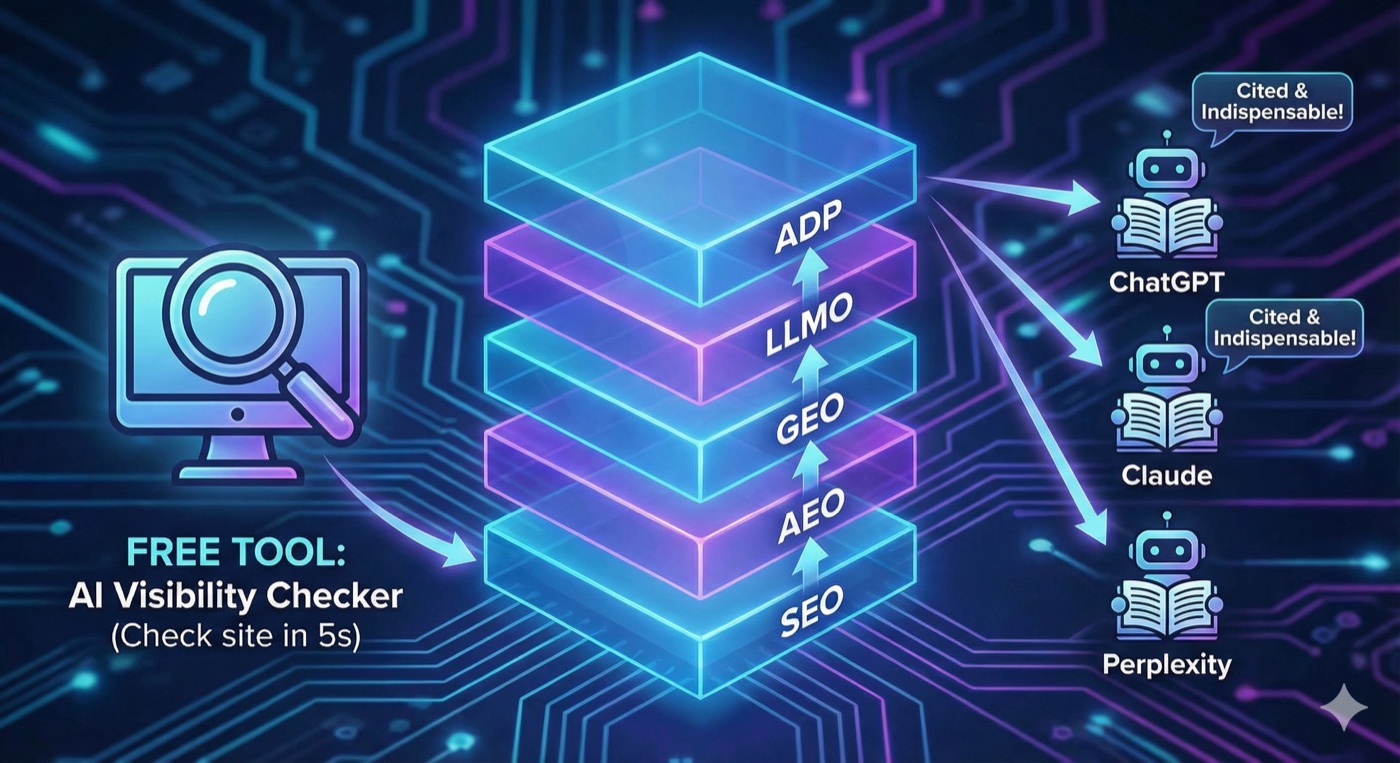
That requires something different. Something we call the Five-Layer Optimization Stack.
What Is the Five-Layer Optimization Stack?
Think of traditional SEO as Layer 1—the foundation. It got you ranked on Google. But ranking is no longer enough.
AI assistants are now primary research tools for over 200 million users. When someone asks ChatGPT "What's the best organic cookie brand?" or tells Perplexity "Find me a press release service for startups," your content needs to be discoverable, understandable, and citable.
That's where the Five-Layer Stack comes in:
| Layer | Acronym | Full Name | What It Does |
|---|---|---|---|
| 1 | SEO | Search Engine Optimization | Gets you ranked on Google (the foundation) |
| 2 | AEO | Answer Engine Optimization | Structures content as direct answers for featured snippets |
| 3 | GEO | Generative Engine Optimization | Makes your content citable by AI-generated answers |
| 4 | LLMO | Large Language Model Optimization | Ensures LLMs interpret your content correctly |
| 5 | ADP | AI Discovery Protocol | Provides machine-readable infrastructure for AI crawlers |
Most companies stop at Layer 1 or 2. They wonder why AI ignores them while competitors get cited.
Layer 1: SEO — The Foundation
You know this one. Meta titles, descriptions, Schema.org structured data, sitemaps. It's table stakes in 2025. Without solid SEO, nothing else matters.
Layer 2: AEO — Answering Questions
Answer Engine Optimization structures your content to appear in featured snippets and "People Also Ask" boxes. FAQ schemas. Clear question-answer formats. This is where most "modern SEO" stops.
Layer 3: GEO — Getting Cited
Generative Engine Optimization is about making AI cite you as a source. When ChatGPT generates an answer, does it reference your content? GEO focuses on explicit facts (not opinions), knowledge graphs, and source attribution in structured data.
Layer 4: LLMO — Guiding Interpretation
Large Language Model Optimization ensures AI interprets your content correctly. This includes /llms.txt files that provide human-readable context, clear entity definitions, and explicit guidance that prevents AI hallucinations about your products or services.
Layer 5: ADP — The Discovery Infrastructure
The AI Discovery Protocol is the technical layer that ties everything together. Machine-readable endpoints (/ai-discovery.json, /knowledge-graph.json) that AI crawlers can directly query without parsing HTML. This is where Pressonify's ADP v3.0 shines.
The Closed-Loop System: From Publication to Citation
Here's what makes our approach different from tools like Dark Visitors.
Dark Visitors shows you who crawled your site. Useful, but passive. You're watching AI visit, not controlling what they find.
ADP v3.0 creates a closed-loop system:
┌──────────────────────────────────────────────────────────────────┐
│                                                                  │
│   Content Created                                                │
│        ↓                                                         │
│   ADP-Native Markup Applied (Five Layers)                        │
│        ↓                                                         │
│   AI Crawlers Discover (GPTBot, ClaudeBot, PerplexityBot)        │
│        ↓                                                         │
│   AI Systems Cite Your Content                                   │
│        ↓                                                         │
│   Users Click Through to Your Site                               │
│        ↓                                                         │
│   Analytics Captured (which AI, when, what query)                │
│        ↓                                                         │
│   Insights Improve Future Content                                │
│        ↓                                                         │
│   [Loop Repeats]                                                 │
│                                                                  │
└──────────────────────────────────────────────────────────────────┘
Why "closed-loop" matters:
- Active, not passive: You control what AI discovers, not just observe what happens
- Complete attribution: Know which AI cited you and drove traffic
- Continuous improvement: Analytics inform content strategy
The goal isn't just visibility. It's indispensability. When AI assistants consistently cite your content as authoritative, you become the default answer.
Check Your AI Visibility: Free Tool
Before you can improve, you need to know where you stand.
That's why we built the AI Visibility Checker—a free tool that analyzes any website's discoverability by AI assistants.
What It Checks (5 Categories, 100-Point Score)
| Category | Max Points | What We Analyze |
|---|---|---|
| Schema.org Structured Data | 30 pts | JSON-LD markup, schema types detected |
| AI Meta Tags | 20 pts | AI-specific meta tags, OpenGraph, Twitter Cards |
| ADP Compliance | 25 pts | /llms.txt, /ai-discovery.json, /knowledge-graph.json |
| Robots.txt AI Friendliness | 15 pts | Are GPTBot, ClaudeBot, PerplexityBot allowed? |
| Page Performance | 10 pts | Load time (AI crawlers prefer fast sites) |
Your Score Means:
- A (90-100): Excellent AI visibility — you're ahead of the curve
- B (75-89): Good visibility — minor improvements needed
- C (50-74): Fair visibility — significant gaps to address
- D (25-49): Poor visibility — AI likely ignoring you
- F (0-24): Very poor — urgent attention required
Why We Built It Free
We believe AI visibility shouldn't be a mystery. Every business deserves to know:
- How AI assistants see their content
- What's blocking discoverability
- Specific steps to improve
Check your site now — it takes 5 seconds.
What ADP v3.0 Actually Does
The AI Discovery Protocol is an open specification that creates a standardized way for AI systems to discover and understand your content.
The 11 Endpoints
| Endpoint | Purpose | Update Frequency |
|---|---|---|
/ai-discovery.json |
Meta-index pointing to all other endpoints | Hourly |
/knowledge-graph.json |
Entity relationships in JSON-LD | Hourly |
/llms.txt |
Human-readable context for LLMs (~1,200 tokens) | Daily |
/llms-full.txt |
Extended context with content summaries | Daily |
/feed.json |
JSON Feed for content updates | Realtime |
/updates.json?since= |
Delta feed for incremental updates | Realtime |
/rss |
RSS feed | Realtime |
/sitemap-ai.xml |
AI-optimized sitemap | Hourly |
/.well-known/ai.json |
Discovery manifest (emerging standard) | Daily |
/.well-known/security.txt |
Security contact (RFC 9116) | Weekly |
/ai-discovery.md |
Human-readable documentation | Hourly |
v2.1 Enhancements
1. Semantic Embeddings
AI understands meaning, not just keywords. "Wireless headphones" = "Bluetooth earbuds" = "cordless audio." Your products get discovered by intent, not exact match.
2. Relationship Graphs
Products explicitly linked to each other. AI can recommend "customers who liked X also bought Y" without guessing.
3. LLM Safety Guidance
Explicit rules telling AI how to use your data safely:
- Never invent prices — only use the price field
- Check availableForSale before recommending
- Cite source URL for each product
This prevents hallucinations like "This product costs $50" when it's actually $500.
4. Differential Updates
SHA-256 checksums enable incremental updates. AI crawlers only download what changed—97% bandwidth reduction. Faster indexing, lower costs.
The Impact: From Invisible to Indispensable
What does implementing the Five-Layer Stack actually achieve?
Before vs. After
| Metric | Without ADP | With ADP v3.0 |
|---|---|---|
| AI Visibility Score | 10-15% | 60-85% |
| Schema Types Detected | 0-2 | 5-8 |
| AI Bot Accessibility | Often blocked | Fully accessible |
| LLM Context Provided | None | 1,200+ tokens |
| Citation Likelihood | Low | High |
The Competitive Advantage
When your competitors are invisible to AI and you're not, you win by default. Every time someone asks ChatGPT a question in your industry, your content is in the running to be cited. Theirs isn't.
This isn't about replacing SEO. It's about extending it for the AI era.
How to Get Started
You have three paths:
1. Free: Assess Your Current State
Use our AI Visibility Checker to get your score and see exactly where you stand. No signup required.
2. DIY: Implement ADP Yourself
The AI Discovery Protocol is an open specification. Read the full documentation and implement the endpoints yourself. Best for developers with time and technical expertise.
3. Done-For-You: Pressonify Press Releases
Every press release published through Pressonify comes with ADP v3.0 baked in:
- All Five Layers optimized automatically
- 5-8 Schema.org types per release
- Full ADP endpoint coverage
- IndexNow instant indexing
Publish an AI-optimized press release in 60 seconds →
Starting at €49, you get professional press release distribution with AI visibility built in from day one.
FAQ
Does this replace SEO?
No. SEO is Layer 1 of the Five-Layer Stack. You still need solid SEO fundamentals. ADP builds on top of traditional optimization—it doesn't replace it.Which AI systems does this work with?
ADP v3.0 is designed to work with all major AI assistants: - ChatGPT (GPTBot) - Claude (ClaudeBot) - Perplexity (PerplexityBot) - Google Gemini - Microsoft Copilot - And emerging AI systems that follow web standardsHow long until I see results?
AI crawlers typically discover new ADP endpoints within hours. Citation improvements depend on your content quality and the queries being asked, but many users see changes within days to weeks.Is my data shared with AI companies?
No. You control the ADP endpoints. They live on your domain. AI systems read them just like they read your website—you're not sending data anywhere.What if I block AI bots in robots.txt?
That's your choice, but it means AI assistants can't see your content. Our AI Visibility Checker will flag this and show you which bots are blocked. Many sites inadvertently block AI crawlers with overly broad rules.The Bottom Line
Google's executive is right: AI search is an "expansionary moment" for the web.
But expansion only benefits those who are visible.
The Five-Layer Optimization Stack—SEO, AEO, GEO, LLMO, and ADP—is how you move from invisible to indispensable. From hoping AI finds you to ensuring it cites you.
Check your AI visibility now and see where you stand.
Or skip ahead: Publish an AI-optimized press release and let us handle all five layers for you.
The expansion is happening. The only question is whether you'll be part of it.
Related Resources
- Free AI Visibility Checker - Get your 100-point score
- Create AI-optimized press release - 60-second publishing
- View pricing plans - Starting at €49
- Read the ADP introduction - Technical deep dive
- Explore our live ADP implementation - See it in action
- View our AI Discovery manifest - Full endpoint listing
- See what's new - Latest features
Published December 10, 2025 | Last updated: December 10, 2025
Source: Google Executive Sees AI Search as Expansion for Web — Reuters/US News, December 4, 2025