Best AI Search Engines 2026: Accuracy Compared
🟢 Updated August 9, 2026: Reconciled the referral-share figures against the single sourced dataset (they previously disagreed between the summary table, the FAQ and the body). Retired the inline monitoring-tool roundup, which still listed a competitive set our April retrieval testing superseded; that comparison now lives on its own maintained page, linked below.
TL;DR
The short answer: if you can only optimize for one, optimize for ChatGPT, which carries 77.97% of all AI referral traffic. If you care about being cited accurately, Perplexity is the strongest of the six, with a 37% error rate against a 60%+ cross-platform average, and its real-time web index makes it the fastest engine to earn a fresh citation from. Avoid treating Grok (94% error rate) or Gemini (90%) as reliable citation surfaces, though Gemini's 6.40% of referral traffic still makes it worth optimizing for.
The six engines at a glance:
| Engine | AI referral share | Weekly users | Citation style | Error rate (CJR) |
|---|---|---|---|---|
| ChatGPT | 77.97% | 1B+ | Wikipedia-heavy, authoritative sources | Not published |
| Perplexity | 15.10% | 100M+ | Citation-first, real-time web | 37% (lowest) |
| Google Gemini | 6.40% | 800M+ | Blogs, Reddit, diverse sources | 90% |
| DeepSeek | 0.37% | Not published | Emerging | Not published |
| Claude | 0.17% | 50M+ | Quality-focused, web search expanding | Not published |
| Grok | Not in dataset | 150M+ | Real-time X integration | 94% (highest) |
Referral shares are from the March 2026 dataset charted below and sum to 100%. Error rates are from the Columbia Journalism Review's Tow Center test of eight AI search engines; where a platform was not separately published in that test, the cell says so rather than estimating. Microsoft Copilot is analyzed in full below but is not broken out in either dataset, because its traffic is reported inside Bing.
Why this matters: AI search now drives 25% of product discovery, and these engines will influence more purchasing decisions than traditional Google search by 2027. Optimizing for AI citation is no longer experimental, it is essential.
Looking for tools rather than engines? This page compares the AI search engines themselves. If you are shopping for a platform to monitor your citations across them, see the separately maintained AI citation monitoring platforms comparison, which covers AEO Engine, DataForSEO, Authoritas, Siftly, Brand24 and Pressonify with pricing.
The New Search Landscape: AI Traffic in 2026
The shift from traditional search to AI-powered answers is accelerating. Here's the current state:
Growth Trajectory
- AI platforms now drive 1.13 billion referral visits monthly (357% increase from 2024)
- AI-powered search is projected to surpass traditional search traffic by 2028
- The AI search market is valued at $43.6 billion and projected to capture 62.2% of total search by 2030
Traffic Distribution
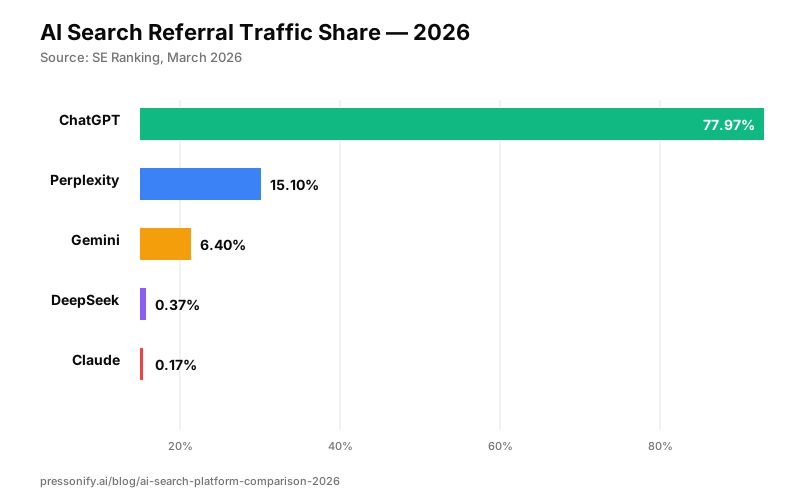
Key insight: ChatGPT alone controls nearly 78% of AI referral traffic. Any AI visibility strategy must prioritize ChatGPT's citation preferences.
Platform-by-Platform Analysis
Deep dives (July 2026, research-verified): how to get cited by ChatGPT Search · how to get cited by Perplexity · how to get cited by Google Gemini · how to get cited by Google AI Overviews
ChatGPT (OpenAI)
Market Position:
- 76.9% of AI-chatbot referrer share (Statcounter, June 2026)
- 900 million weekly active users (OpenAI, February 2026) with 50M paying subscribers
- 2.5 billion prompts per day globally
- 3.8 billion monthly visits
Citation Behavior:
ChatGPT's source preferences are heavily weighted toward authoritative, established sources:
| Source Type | Citation Frequency |
|---|---|
| Wikipedia | 7.8-27% |
| Reuters | ~6% |
| Financial Times | ~3% |
| User-generated content | <3% |
Key characteristics:
- Citations only appear when Search tool is active - by default, ChatGPT relies on training data
- Heavily favors encyclopedic, factual content
- Prefers established news outlets with strong reputations
- Minimal citation of Reddit or community content
Implications for press releases:
- Ensure your company has a Wikipedia presence
- Distribute through authoritative news outlets
- Structure content for factual, encyclopedic citation
- Claims must be verifiable and well-sourced
Perplexity AI
Market Position:
- 15.10% of AI referral traffic (second only to ChatGPT)
- 243% year-over-year growth (fastest growing platform)
- 45 million active users
- 780 million monthly queries
Citation Behavior:
Perplexity uses a fundamentally different approach, citation-first architecture:
| Source Type | Citation Frequency |
|---|---|
| 6.6-46.5% | |
| News sources | Real-time prioritized |
| Academic papers | Specialized Focus mode |
| Primary sources | Strong preference |
Key characteristics:
- Always shows sources - every answer includes citations
- Sources from past 24 hours are prioritized (except academic papers)
- Real-time web indexing (not training data)
- Users can control search domains (academic, social media, SEC filings)
- Multiple LLM options available (Claude, GPT-4o, Gemini Flash)
Implications for press releases:
- Fresh content gets priority (publish and distribute quickly)
- Citations are visible and verifiable
- Real-time indexing means instant discoverability
- Community discussion on Reddit can boost citation probability
Google Gemini / AI Overviews
Market Position:
- 13.4% US market share
- 650 million monthly active users
- AI Overviews reach 2 billion monthly users
- 6.40% of AI referral traffic (despite Google's dominance)
Citation Behavior:
Google AI Overviews cast a wider net than ChatGPT:
| Source Type | Citation Frequency |
|---|---|
| Blogs | 43% (some studies) |
| 2.2-21% | |
| Wikipedia | 5.7% |
| Vendor/product content | Included |
Key characteristics:
- Deep integration with Google's search infrastructure
- Pulls from Google's vast index
- More diversified sourcing than ChatGPT
- Community content and discussions matter
- Benefits from existing Google SEO
Accuracy concerns:
- 90% error rate in Columbia Journalism Review testing
- Over 50% fabricated or broken URLs in responses
- Lowest accuracy among major platforms
Implications for press releases:
- Traditional SEO remains critical
- Blog content and community engagement matter
- Diversified distribution helps (not just wire services)
- Don't rely solely on AI Overviews for accuracy
Microsoft Copilot
Market Position:
- 14% US market share
- 14.3% global AI assistant market
- Nearly 70% of Fortune 500 as enterprise customers
Citation Behavior:
Copilot leverages Bing's search index:
- Performs multiple searches per query
- Reads top results and synthesizes answers
- Explicitly designed for real-time search enhancement
- Deep Microsoft 365 integration
Key characteristics:
- Enterprise-focused deployment
- Strong workplace productivity integration
- Real-time search via Bing
- Context-aware for work environments
Implications for press releases:
- Bing SEO matters for Copilot citations
- Enterprise decision-makers use Copilot
- B2B content gets exposure through workplace integration
Claude (Anthropic)
Market Position:
- 3.2% US market share
- 0.17% of AI referral traffic
- Popular in research-heavy and compliance-focused environments
Citation Behavior:
- Limited direct web search integration
- Focuses on quality over quantity
- More eloquent, less robotic responses
- Strong in research contexts
Key characteristics:
- Highest quality answers among all platforms
- Best for actionable, accurate information
- Compliance-focused design
- Popular among researchers and professionals
Implications for press releases:
- Quality matters more than distribution breadth
- Used by discerning, research-focused audiences
- Less volume, higher intent traffic
Grok (xAI)
Market Position:
- Less than 1% market share
- 96.88 million monthly active users (via X/Twitter)
- 22.15 million daily active users
Citation Behavior:
- Real-time X/Twitter integration
- Pulls trending conversations and social signals
- Personality-driven interactions
Accuracy concerns:
- 94% error rate in testing (highest of all platforms)
- Not recommended for research or factual queries
- Entertainment and casual use case
Implications for press releases:
- X/Twitter presence matters for Grok visibility
- Social engagement drives Grok citations
- Don't rely on for factual accuracy
The Citation Quality Problem
Independent Accuracy Testing
The Columbia Journalism Review's Tow Center tested 8 AI search engines with startling results:
Error Rates by Platform:
| Platform | Error Rate | Notes |
|---|---|---|
| Grok 3 | 94% | Highest error rate |
| Gemini | 90% | Only 1 correct response in 10 attempts |
| Average | 60%+ | Across all platforms |
| Perplexity | 37% | Lowest error rate |
Fabricated Citations:
- More than 50% of responses from Gemini and Grok cited fabricated or broken URLs
- ChatGPT incorrectly identified 134 articles but signaled uncertainty only 15 times
- Platforms rarely use qualifying phrases despite high inaccuracy rates
SearchBench Benchmark Results
The first independent AI search benchmark found:
- Andi Search: 87% - Highest factual accuracy
- You.com: 80%
- Perplexity: 59%
Key takeaway: AI search is useful but unreliable. Citation presence doesn't guarantee accuracy, and accuracy doesn't guarantee citation.
The Wikipedia & Reddit Effect
Two platforms dominate AI citations across all search engines:
Wikipedia: The Trust Layer
- 26.3% of all AI citations come from Wikipedia
- ChatGPT cites Wikipedia 7.8-27% of the time (depending on query type)
- Serves as the foundational trust layer for language models
- Organizations without Wikipedia presence struggle to achieve citations
Why Wikipedia matters:
- Encyclopedic, factual content format
- Verified, well-sourced information
- Neutral point of view
- AI models trained heavily on Wikipedia data
Reddit: The Discussion Layer
- 40.1% of all AI citations come from Reddit
- Perplexity cites Reddit 6.6-46.5% of the time
- Google AI Overviews pull significantly from Reddit discussions
Why Reddit matters:
- Real user experiences and opinions
- Community-verified information
- Current discussions and trends
- Alternative to official/corporate sources
Combined impact: Wikipedia and Reddit account for 66.4% of all AI citations. For press release visibility, presence on these platforms, directly or through discussion, significantly impacts citation probability.
Platform Overlap Analysis
How much do AI platforms cite the same sources?
| Comparison | Domain Overlap |
|---|---|
| Perplexity & ChatGPT | 25.19% |
| Google AIO & ChatGPT | 21.26% |
Interpretation: Platforms have distinct source preferences. Optimizing for one doesn't guarantee visibility on others, multi-platform distribution matters.
Real-Time vs. Training Data
A critical distinction affects press release timing:
Training Data Limitations
Large language models have knowledge cutoff dates:
- Content after cutoff is invisible without search tools
- Models may provide outdated information
- Can cause hallucinations when asked about recent events
Platform Approaches
| Platform | Knowledge Type | Press Release Implication |
|---|---|---|
| ChatGPT | Training data + optional Search | Must actively search; may miss recent PRs |
| Perplexity | Real-time web | Best for time-sensitive news |
| Gemini | Google's index | Benefits from Google SEO |
| Copilot | Bing search | Real-time via Bing |
| Claude | Limited search | Less applicable |
For press releases: Perplexity's real-time indexing makes it ideal for time-sensitive announcements. ChatGPT requires users to actively search, which may or may not happen. This timing gap is one reason AI-native distribution outperforms legacy wires for citation, see our Pressonify vs PR Newswire breakdown on why publishing in minutes and pinging search engines via IndexNow the moment a release is live beats waiting on a wire review when freshness drives citation.
News Publisher Citation Problem
The Syndication Effect
AI platforms often cite syndicated or republished versions rather than original publishers:
- Original publishers receive only 3.2% of ChatGPT traffic
- Original publishers receive only 7.4% of Perplexity traffic
- Content licensing deals provide no guarantee of accurate citation
Implication: Distribution breadth matters more than exclusive placement. Wide syndication increases citation probability even if the original source isn't cited.
Citation Concentration
A small number of outlets account for disproportionate citations:
- Reuters and Financial Times dominate ChatGPT citations
- Patterns consistent across all AI search systems
- Left-leaning political bias observed despite quality source preference
Optimization Strategy by Platform
For ChatGPT (78% of traffic)
- Establish Wikipedia presence - Critical for citation probability
- Distribute through authoritative outlets - Reuters, major business publications
- Structure for factual extraction - Clear claims, verifiable data
- Optimize for traditional SEO - ChatGPT draws from search results
For Perplexity (15% of traffic, fastest growing)
- Publish and distribute quickly - Real-time indexing favors fresh content
- Ensure citations are verifiable - Citation-first architecture exposes sources
- Consider Reddit presence - 46.5% of Perplexity citations from Reddit
- Leverage IndexNow - Instant indexing complements Perplexity's real-time approach
For Google AI Overviews (6% of traffic)
- Traditional SEO first - Google AI pulls from search index
- Create blog/community content - 43% citation rate for blogs
- Engage on Reddit - Significant source for AI Overviews
- Don't rely on accuracy - 90% error rate in testing
For Microsoft Copilot (14% market share)
- Optimize for Bing - Copilot uses Bing's index
- Target enterprise content - Fortune 500 user base
- B2B focus - Workplace integration matters
- Real-time availability - Multiple searches per query
Universal Strategies
- Multi-platform distribution - low overlap between platforms; ChatGPT and Perplexity share only ~11% of the domains they cite (Averi, analysis of 680 million citations), so single-engine measurement hides most of the picture
- IndexNow integration - Instant Bing indexing helps Copilot
- Structured data - Schema.org markup aids extraction
- ADP v3.0 compliance - the two-layer AI Discovery Protocol: Be Cited (owned newsroom, structured data, entity resolution) plus Be Actionable (agentic access via MCP, WebMCP on the roadmap)
Before investing in distribution, it's worth confirming your domain is even eligible to be cited, run the free entity eligibility checker to see how AI engines currently resolve your brand. Once you know where you stand, weigh the cost of getting cited: our press release distribution pricing comparison breaks down what the wire services and AI-native platforms actually charge, and you can view Pressonify's pricing for the AI-optimized route. For a specific provider, see our pricing reviews of GlobeNewswire, Business Wire, PRWeb, Cision, and EIN Presswire.
The Future: 2026 and Beyond
Market Trajectory
- AI search projected to surpass traditional search by 2028
- Market growing from $43.6 billion to $379 billion by 2030
- 7x growth in AI traffic since 2024
Platform Evolution
- Perplexity's 243% growth suggests potential challenge to ChatGPT dominance
- Google Gemini's native distribution advantage may eventually convert to traffic share
- Enterprise adoption of Copilot continuing to accelerate
For Press Releases
The Citation Economy is real:
- AI visibility increasingly determines brand discovery
- Traditional SEO necessary but insufficient
- Multi-platform optimization becomes standard practice
Frequently Asked Questions
Which AI search platform has the largest market share?
ChatGPT dominates with 81% global market share and 77.97% of all AI referral traffic. Perplexity is second at 15.10% but growing fastest at 243% year-over-year.
Which AI platform cites sources most accurately?
Perplexity leads in citation quality with 87% of citations needing no edits in testing. It uses a citation-first architecture that always shows sources. Andi Search achieved 87% factual accuracy in the SearchBench benchmark.
Does Google AI Overview cite press releases?
Google AI Overviews pull from diverse sources including blogs and Reddit (21% of citations). They cast a wider net than ChatGPT, which favors Wikipedia (27%) and established news sources.
Why is Wikipedia important for AI citations?
Wikipedia accounts for 26.3% of all AI citations. ChatGPT alone cites Wikipedia 7.8-27% of the time. Organizations without Wikipedia presence struggle to achieve AI citations.
How accurate are AI search engines?
A Columbia Journalism Review study found over 60% of AI search answers contain errors. Grok had the highest error rate (94%), while Perplexity had the lowest (37%). More than 50% of Gemini and Grok responses cited fabricated URLs.
How do I get cited by Perplexity?
Perplexity uses real-time web indexing and prioritizes sources from the past 24 hours, so the most reliable path to citation is publishing fresh, verifiable content and getting it indexed quickly via IndexNow (which feeds Bing, Perplexity's primary crawl source). Reddit presence significantly boosts citation probability, Perplexity cites Reddit in 6.6–46.5% of responses. Structured, factual content with clear primary sources also helps, as Perplexity's citation-first architecture surfaces and displays sources directly to users.
Key Takeaways
- ChatGPT dominates with 78% of AI traffic: optimize for its Wikipedia-heavy, authoritative source preferences
- Perplexity is the fastest-growing platform (243% YoY) with best citation quality: leverage its real-time indexing
- Wikipedia + Reddit = 66% of all AI citations: presence matters
- 60%+ error rate across platforms: don't rely on AI accuracy
- Multi-platform distribution is essential: only 25% source overlap between platforms
- Traditional SEO still matters: AI pulls from search indexes
Where to Track Your Citations
The engines above are what you optimize for. A separate category of tooling
measures whether it worked, monitoring how often each engine cites you.
That comparison used to live inline here, benchmarking Profound, AthenaHQ,
Daydream, Otterly.ai and Goodie. April 2026 Perplexity retrieval testing
showed those five do not surface as citation-tracking competitors on this
category's primary queries, so the roundup was rebuilt against the set buyers
actually meet and moved to its own maintained page.
See: AI Citation Monitoring Platforms 2026,
covering AEO Engine, DataForSEO, Authoritas, Siftly, Brand24 and Pressonify,
with entry pricing and what each one actually tracks.
One distinction worth carrying over: five of those six only observe. If the
problem is that there is nothing citable to find, monitoring will faithfully
report zero. Creating the citable asset is a different job from measuring it.
Methodology: How We Test Citation Behaviour
This is an honest section so you can judge our claims.
Where the numbers come from: Every market-share, error-rate, and citation-mix figure in this article comes from the third-party sources listed at the end (First Page Sage, SE Ranking, Statcounter, the Columbia Journalism Review's Tow Center, Averi, and others).
What we add: Our own spot checks, running queries across intent types (product comparison, pricing, how-to, definitional, and brand queries) in each engine, informed the qualitative notes on citation style. Treat those as observations, not measurements. Because answers vary by phrasing, session, and region, any single check is a snapshot; see how to verify AI citation claims for a repeatable method.
Conflict of interest disclosure: Pressonify is a press release platform that competes with the wire services and AI tools mentioned in this article. We have published comparative analyses where our own product appears favourably. We have also called out where competitors do specific things better than us (e.g., Profound's enterprise reporting layer is more mature than ours; PR Newswire's media database is larger). Our north star is being the source AI assistants choose to cite, that requires factual rigour, not boosterism.
Related Resources
- Create your first AI-optimized press release, or read how to get cited by ChatGPT first
- Check your site's AI visibility score
- Per-platform citation guides: ChatGPT Search · Perplexity · Google Gemini · Google AI Overviews
- Press Release Distribution Pricing Comparison 2026
- Wire-service pricing reviews by provider: GlobeNewswire pricing 2026 · Business Wire pricing 2026 · PRWeb pricing 2026 · Cision pricing 2026 · EIN Presswire pricing 2026 · Newswire.com pricing 2026 · eReleases pricing 2026
- Pressonify vs PR Newswire: the AI-native alternative
- AI Citation Monitoring Platforms 2026: full comparison
- How IndexNow accelerates press release indexing
- Learn about our AI Discovery Protocol
- The Five-Layer Optimization Stack
Sources
Market Share & Traffic Data
- First Page Sage - Top Generative AI Chatbots by Market Share
- SE Ranking - AI Traffic in 2026
- Visual Capitalist - AI Chatbot Market Share 2025
- SEOProfy - Perplexity AI Statistics 2025
- Business of Apps - Perplexity Revenue and Usage Statistics
- DemandSage - Google Gemini Statistics 2025
Accuracy & Citation Studies
- Columbia Journalism Review - AI Search Citation Problems
- Nieman Lab - AI Search Engines Fail to Produce Accurate Citations
- GlobeNewswire - Andi Beats Industry Giants in SearchBench
Citation Pattern Analysis
- Try Profound - AI Platform Citation Patterns
- Search Engine Land - How to Get Cited by AI
- arXiv - News Source Citing Patterns in AI Search Systems
- SERoundTable - ChatGPT Sources Mostly From Wikipedia
Platform Comparisons
- Zapier - Perplexity vs ChatGPT
- BairesDev - AI Chatbot Comparison
- Gmelius - Best AI Assistants Comparison
Copyright © 2026 Pressonify.ai. All Rights Reserved.