SaaS Link Building: Six Ways to Earn Links Without Buying Them
SaaS link building works when you build something worth linking to and then tell people it exists. Bought links, bulk directory submissions and links dropped into forum threads are all on Google's published list of link spam. This guide covers six methods that are not, says what Google's own documentation states about each, and lists the directories and request services we opened ourselves on 22 November 2026.
What Google says about links
Google's documentation was read on 22 November 2026.
| Source | What it says |
|---|---|
| Spam policies, link spam (updated 28 August 2026) | "Link spam is the practice of creating links to or from a site primarily for the purpose of manipulating search rankings." Its examples include "Buying or selling links for ranking purposes", "Low-quality directory or bookmark site links" and "Forum comments with optimized links in the post or signature" |
| Qualify your outbound links (updated 10 December 2025) | "Mark links that are advertisements or paid placements (commonly called paid links) with the sponsored value." |
| Link best practices (updated 10 December 2025) | "Good anchor text is descriptive, reasonably concise, and relevant to the page that it's on and to the page it links to." |
| Creating helpful content (updated 5 October 2026) | Asks of any page: "Does the content provide original information, reporting, research, or analysis?" |
The pattern in all four is the same. A link a company places for itself is discounted or penalised. A link someone else chooses to add, because the page was useful to their readers, is the kind Google is trying to count.
What a nofollow link is still worth
Some of the links a young company can get are marked nofollow, such as profile pages and some directory listings. They are still worth having.
In September 2019 Google changed how it treats the attribute: the sponsored, ugc and nofollow attributes "are treated as hints about which links to consider or exclude within Search." It added: "For crawling and indexing purposes, nofollow will become a hint as of March 1, 2020."
Google's outbound links page says links with these attributes "will generally not be followed", and that the linked pages "may be found through other means, such as sitemaps or links from other sites, and thus they may still be crawled."
So a nofollow link is not a ranking vote you can count on, and it is not nothing. On a page people read it sends visitors, and it puts your company's name where a writer or an AI answer engine can find it. Our post on whether press releases get backlinks covers the same rule for links inside a release.
1. Publish original data
A writer who needs a number will link to the page the number came from. That makes a study a link asset a small company can build on its own.
- Combine public data. Government and industry datasets are free. Joining two of them to answer a question in your field gives you a figure nobody else has published.
- Audit your sector. Check a few hundred public websites in one industry for one thing, and publish the count.
- Publish what you already measure. Your own product produces numbers. We publish ours in what our tracking shows about press release coverage.
Whatever the source, show the method: what you measured, how many, on which dates and what you left out. A figure without a method is hard to cite, and a writer who cannot check it will not use it.
A free tool does the same job as a study. Our AI Citation Source Finder shows which pages an AI engine cites for a topic, and each result is a small piece of data the visitor could not get elsewhere.
2. Draw the diagram
Writers reuse good diagrams, and a reused diagram can carry a credit.
- Draw things that explain. A flowchart, a comparison, a framework. Decoration does not get reused.
- Add alt text. Google's link documentation says: "For images as links, Google uses the alt attribute of the img element as anchor text". The alt text is what a linked image says about your page.
- Choose a licence that asks for credit. A Creative Commons Attribution licence asks anyone reusing the image to credit you. Flickr lets you add a Creative Commons licence to your uploads, and Wikimedia Commons accepts only freely licensed media. The licence pages of Unsplash, Pexels and Pixabay say attribution is not required there, so they are the wrong place if a credit is the point.
- Check where the image went. Every two or three months, run a reverse image search on your diagrams. Where a site used one without credit, thank them and ask for a link to the source. It is a request, not a right.
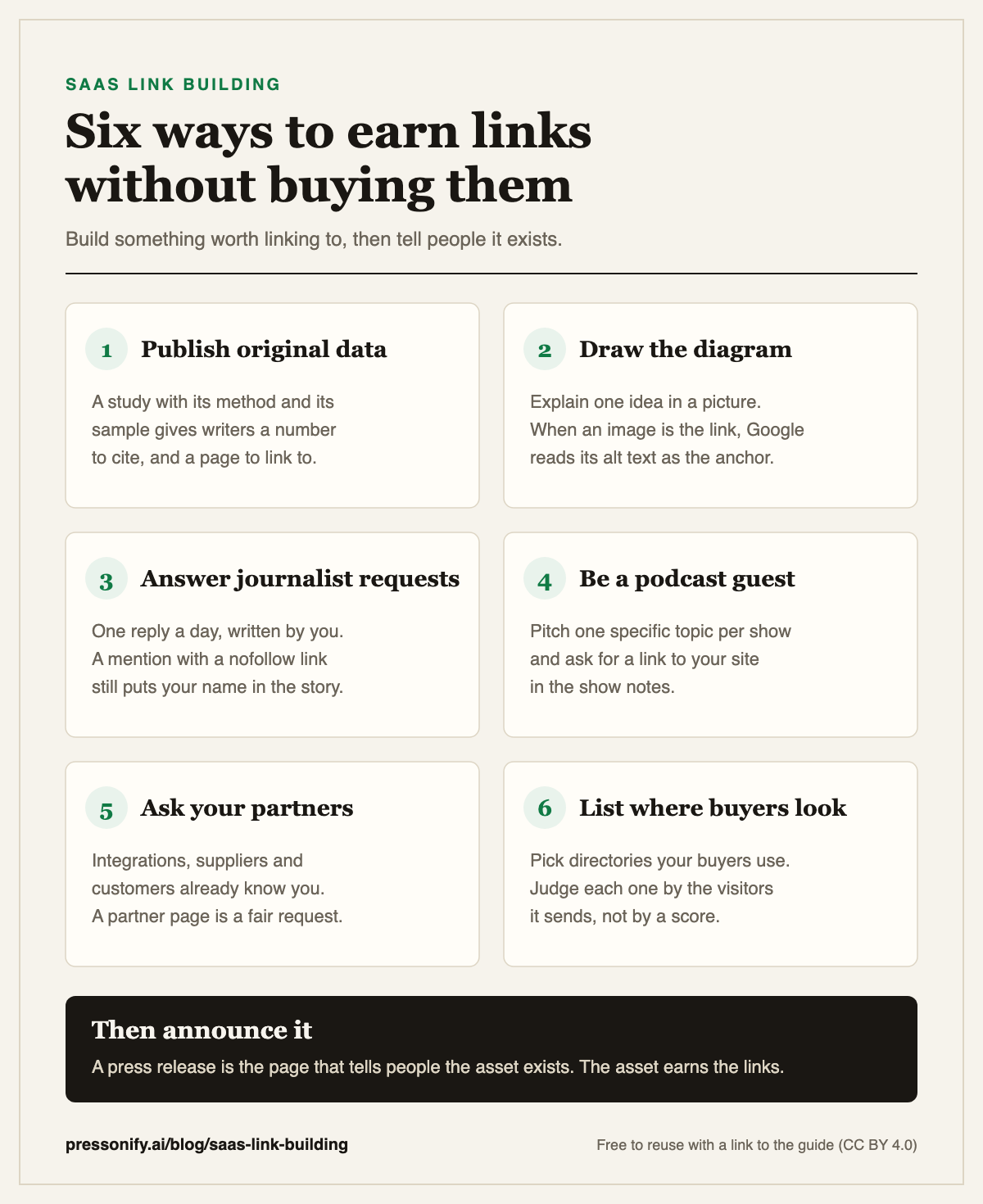
This guide follows its own advice. The image above is free to reuse under CC BY 4.0. Copy this to embed it with its credit:
<a href="https://pressonify.ai/blog/saas-link-building"><img src="https://pressonify.ai/static/images/blog/saas-link-building-six-ways.png" alt="Six ways a SaaS company earns links without buying them" width="600"></a>
<p>Source: <a href="https://pressonify.ai/blog/saas-link-building">SaaS Link Building, Pressonify</a> (CC BY 4.0)</p>
3. Answer journalist requests
Journalists post requests for expert comment, and several services pass them on by email. We opened each of these on 22 November 2026:
| Service | What its site says | Cost for the expert |
|---|---|---|
| HARO | Connects journalists with sources; the site says it is powered by Featured | Free daily queries |
| Source of Sources | A daily email of journalist queries, run by the founder of HARO | Free |
| Qwoted | A network of journalists and experts | Free account, paid plans |
| Featured | Find opportunities and submit pitches; requests are behind a login | See its pricing page |
| ResponseSource | Connects media with sources; UK based | Free trial, then paid |
Pick two and answer one request a day. Write the answer yourself, keep it short, and say something specific from your own work. Nobody can promise that a reply is used or that a story links to you. Our journalist outreach rules cover how to write to a reporter directly.
4. Be a podcast guest
If podcasts in your field interview guests, pitch one specific topic per show, not your product, and ask for a link to your site in the show notes. The episode page is a page about you, on a site your buyers already follow.
5. Ask your partners
The easiest links come from people who already know you.
- Integrations. If your product connects to another, ask to be listed on its integrations or partners page.
- Suppliers and customers. A supplier may list its customers; a customer may write about the tools it uses.
- Communities you belong to. Answer questions where you are already a member. Google's spam policy lists "Forum comments with optimized links in the post or signature" as link spam, and many communities have rules against self-promotion, so a link belongs in an answer only when it is the answer.
6. List in the SaaS directories buyers use
Google names "Low-quality directory or bookmark site links" as link spam, so the test for SaaS directories and startup directories is simple: would a buyer look for you there?
We opened each of these on 22 November 2026 and wrote down what its own page said. We list no authority scores.
| Site | What it is | Cost to list |
|---|---|---|
| SaaSHub | Software alternatives directory | Free; you submit and wait for approval |
| AlternativeTo | Crowd-sourced alternatives to apps and services | Not stated on the page we read |
| Uneed | Launch platform for tech products | Free queue with a date at least 50 days out, or $39.99 to skip it |
| PitchWall | Directory of AI products | Free with a minimum 30-day wait; $49 or $99 to go sooner |
| Fazier | Daily product launches | Free tier listed within 30 days, which requires a link to Fazier on your site; paid tiers do not |
| BetaList | Early-stage startup discovery | Paid; you pick a plan after submitting |
| SideProjectors | Marketplace for side projects | Free basic submission, reviewed before approval |
| Clutch | Marketplace for B2B service companies | Free basic profile with no link to your website from directory pages; Verified is $499 a year |
| Tracxn | Startup database | Request form; an analyst contacts you |
| D-U-N-S Number | A business identifier, not a listing | Free; up to 30 business days |
Three things stand out. The free queues are slow, so submit early. A free tier that requires a link back from your site is an exchange, and Google lists "Excessive link exchanges" as link spam, so do it sparingly. And a paid launch is an advert: worth it when the site's readers are your buyers.
Product Hunt, G2, Capterra, GetApp, Software Advice, Peerlist, Indie Hackers, F6S, Gust, EU-Startups, Bing Places and Google Business Profile blocked our automated check that day, so we make no claim about them here. They are in the tracker as "not checked" for you to open yourself.
Paying for a placement
Paying for a link that passes ranking credit is the first example on Google's link spam list. Paying for a placement is allowed when the link is marked, and Google's 2019 post says how: use rel="sponsored" or rel="nofollow".
That changes the question to ask. A marked link is not there to lift rankings, so the only thing a paid launch slot, a newsletter sponsorship or an event listing can give you is readers. Ask how many people will see it and whether they are buyers.
Where a press release fits
A press release does not build links by itself. Google's spam policy names "links with optimized anchor text in articles, guest posts, or press releases distributed on other sites" as link spam, and the link from a Pressonify release page to your site is marked rel="sponsored" for that reason.
What a release does is announce the asset. When you publish a study or launch a tool, the release is the dated page that says what it is, who made it and where to find it, in your words. It is what you send to the people who write about your field, and what an AI answer engine can cite. The study earns the links; the release tells people the study exists. The AI press release generator drafts one from a few lines about what is new.
A 90-day plan
Days 1 to 30: foundations
- Check that each landing page names its search phrase in the title, the address, the main heading and the first sentence.
- Submit to the free queues first, because they take 30 to 50 days.
- Sign up for two request services and answer one request a day.
- List your partners, integrations and suppliers, and ask each one for a listing.
Days 31 to 60: assets
- Draw three to five diagrams and publish each on your own site with alt text and a credit line.
- Upload them to Flickr or Wikimedia Commons under a Creative Commons attribution licence.
- Pitch five podcasts with one specific topic each.
- Choose the question your study will answer and collect the data.
Days 61 to 90: publish and tell people
- Publish the study with its method and its sample.
- Announce it with a press release, and tell the writers in your field one at a time.
- Run a reverse image search on your diagrams and ask for credits.
- Count visits from each link, not the number of links. Our guide to what founders should measure covers the numbers that matter.
The tracker below has the directories, the request services and this plan as a checklist.
Related Reading
- Do Press Releases Still Get You Backlinks?
- Journalist Outreach: 7 Rules to Get Your Press Release Covered
- Do Press Releases Get Media Coverage? What Tracking Shows
- SEO for Press Releases: The Complete Guide
- AI Citation Source Finder
Written by the Pressonify team in Dublin. We opened every site named in the tables on 22 November 2026 and recorded what its own page said. Prices and rules change, so read the page before you pay.